The UK is facing a big shortage of nurses. This has made UK visa sponsorship for nurses very important for those wanting to work in UK healthcare.
The UK government has created special visas for skilled nurses. The Health and Care Worker Visa makes it easier for healthcare professionals to come to the UK.
With a shortage of nurses in the UK, it’s key for nurses around the world to know about visa sponsorship. This is for those who want to work in the UK.
Key Takeaways
- The UK is facing a significant nursing shortage, creating opportunities for international nurses.
- The Health and Care Worker Visa is a key visa option for nurses looking to work in the UK.
- Understanding the eligibility criteria and application process is crucial for successful visa sponsorship.
- Nurses can work in various healthcare settings across the UK with the right visa sponsorship.
- The UK government is actively promoting visa sponsorship for healthcare professionals.
The Current State of Nursing in the UK
The need for nurses in the UK is at an all-time high. This is due to an aging population and more people needing healthcare. The lack of nurses is making the UK’s healthcare system very critical.
Nursing Shortages and Demand
The UK is facing a big shortage of nurses. This is affecting how healthcare services are delivered. The NHS is short by thousands of nursing professionals.
This shortage comes from an aging workforce and not enough new nurses being hired.
Opportunities for International Nurses
The nurse shortage in the UK is opening doors for international nurses. The NHS and other healthcare providers are looking for nurses from all over. This is a great chance for nurses to gain experience and help the UK’s healthcare.
Understanding UK Visa Options for Nurses in 2026
The UK is facing a nursing shortage. For international nurses, knowing the visa options for 2026 is key. The UK government has created special visas for skilled healthcare workers.
Health and Care Worker Visa
The Health and Care Worker Visa is for nurses and other healthcare workers with a UK job offer. It has perks like fast-tracked processing and no Immigration Health Surcharge. To qualify, nurses need a job offer from a UK employer and meet skill and salary standards.
Applicants must also register with the UK’s Nursing and Midwifery Council (NMC) before starting work.
Skilled Worker Visa
The Skilled Worker Visa is for nurses with a UK job offer. It needs a job offer from a licensed sponsor and meets skill and language standards. This visa is points-based, with points for job offer, salary, and language skills.
While the Skilled Worker Visa is more general than the Health and Care Worker Visa, it’s still a good option for those who qualify.
Eligibility Requirements for Nursing Visa Sponsorship
To get a nursing visa in the UK, you need to meet certain educational, experience, and character requirements. It’s important to check if you meet these to get your visa.
Educational Qualifications
You must have a recognized nursing degree or diploma. This means your qualification should be approved by the Nursing and Midwifery Council (NMC). Check if your qualification is on the NMC’s approved list.
Work Experience Requirements
Having work experience is helpful but not always needed. Employers in the UK often look for candidates with experience. You’ll need to show your work history, including job titles and skills.
Character and Health Requirements
You also need to meet character and health requirements. This includes passing background checks and showing you’re healthy. The UK’s rules say you must be of good character and not a health risk.
By focusing on these areas, nurses can make sure they’re eligible for a nursing visa in the UK.
How to Get UK Visa Sponsorship for Nurses 2026
To get a UK visa sponsorship as a nurse in 2026, you need a plan. First, find the right employer. Then, understand their rules and make a strong application.
Finding Eligible Employers
Start by looking for employers who can sponsor nurses. These are usually healthcare providers with a valid license.
NHS Trusts and Opportunities
NHS trusts are big employers of nurses in the UK. They often sponsor nurses because there’s a big need for healthcare workers. NHS trusts offer many opportunities in different areas, making them a key source of sponsorship.
Private Healthcare Providers
Private healthcare providers also sponsor nurses. They might offer better pay and benefits, which is appealing to international nurses. Private healthcare providers have their own rules, so it’s important to check what they need.
Approaching Potential Sponsors
After finding potential employers, it’s time to apply. Make sure your resume and cover letter show off your skills and experience.
Creating an Effective Application
Your application needs to stand out. Keep your resume current and focus on your nursing skills and experience. Your cover letter should explain why you’re a good match for the job and employer.
Interview Preparation
Getting ready for an interview is crucial. Learn about the employer, practice common questions, and be ready to talk about your nursing background.
Nursing and Midwifery Council (NMC) Registration Process
International nurses need to go through the NMC registration process. This is to make sure they meet the UK’s nursing standards. It’s important for proving their qualifications and skills to work in the UK’s healthcare system.
Test of Competence Requirements
The Test of Competence is a key part of the NMC registration. It checks if a nurse can work safely and well in the UK. It has two main parts:
- Computer-Based Test (CBT): This test checks a nurse’s knowledge of nursing practices.
- Objective Structured Clinical Examination (OSCE): This exam tests a nurse’s clinical skills and how they apply their knowledge in real situations.
Computer-Based Test (CBT)
The CBT is an online test that covers many nursing topics. It includes medication management, care planning, and patient assessment. Nurses must show they understand these important areas to pass.
Objective Structured Clinical Examination (OSCE)
The OSCE is a practical test that checks a nurse’s clinical skills in a simulated setting. It looks at their ability to work with patients, do assessments, and follow care plans.
Documentation for NMC Registration
To finish the NMC registration, nurses need to provide certain documents. These include:
- Proof of identity and nationality
- Qualification certificates
- Evidence of English language skills
- Details of their current and past nursing registrations
Nurses should make sure all documents are correct and up-to-date. This helps avoid delays in the registration process.
English Language Proficiency Requirements
Nurses wanting to work in the UK must show they can speak English well. This is key for good communication between doctors and patients.
Accepted English Tests
The UK has a few English tests for nurses. IELTS and OET are the most accepted.
IELTS Requirements
IELTS needs a score of 7.0 in each part. You must get at least 7.0 overall. It tests your reading, writing, speaking, and listening.
OET Requirements
OET requires a grade B or 350 in each part. It’s made for healthcare workers, so many nurses choose it.
Preparation Strategies
To do well in these tests, nurses should prepare well. Get to know the test format and practice with sample questions. Also, improve your English by reading and talking more.
| Test | Minimum Score/Grade |
|---|---|
| IELTS | 7.0 overall and in each module |
| OET | Grade B or 350 in each sub-test |

The Visa Application Process Step-by-Step
Applying for a UK visa can seem hard, but it’s easier when you break it down. The process has several key steps, from starting online to submitting your documents.
Online Application Procedures
The first thing to do is fill out the online application form. You need to create an account on the UK government’s visa website. Then, fill out the form with your personal and work details.
Tips for completing the online application:
- Have all necessary documents ready before starting the application.
- Double-check all information for accuracy.
- Save your progress regularly to avoid losing data.
Biometrics and Supporting Documents
After you’ve filled out the online form, you’ll need to give biometric data and submit documents. This includes fingerprints and a photo. You’ll also need to provide documents like your passport, qualifications, and proof of English.
It’s important to have all your documents ready for a smooth application. Here’s a list of what you’ll need:
- Valid passport
- Proof of nursing qualifications
- Evidence of English language proficiency
- Certificate of Sponsorship from an approved UK employer
- Proof of maintenance funds
Common Application Mistakes
Knowing common mistakes can help you avoid them. Some mistakes include:
- Incomplete or inaccurate information on the application form
- Failure to provide required supporting documents
- Insufficient proof of maintenance funds
By knowing these mistakes, you can make sure your application is right.
Financial Requirements and Costs
Nurses wanting to work in the UK face several financial hurdles. It’s key to understand these costs to plan well and ensure a smooth move.
Visa Application Fees
The visa application fee changes based on the visa type and the applicant’s situation. For a Health and Care Worker visa, the cost is between £625 and £1,408. This depends on whether you apply from outside or inside the UK.
Immigration Health Surcharge
The Immigration Health Surcharge (IHS) is a big expense. Nurses must pay £624 each year. This gives them access to the UK’s National Health Service (NHS).
Maintenance Funds Requirements
Applicants need to show they have enough maintenance funds for when they arrive in the UK. You usually need at least £1,270 in savings. But, this can change based on your personal situation.
| Cost Component | Amount (£) | Description |
|---|---|---|
| Visa Application Fee | 625 – 1,408 | Fee for Health and Care Worker visa application |
| Immigration Health Surcharge | 624/year | Annual surcharge for NHS access |
| Maintenance Funds | 1,270 | Minimum required savings for self-support |
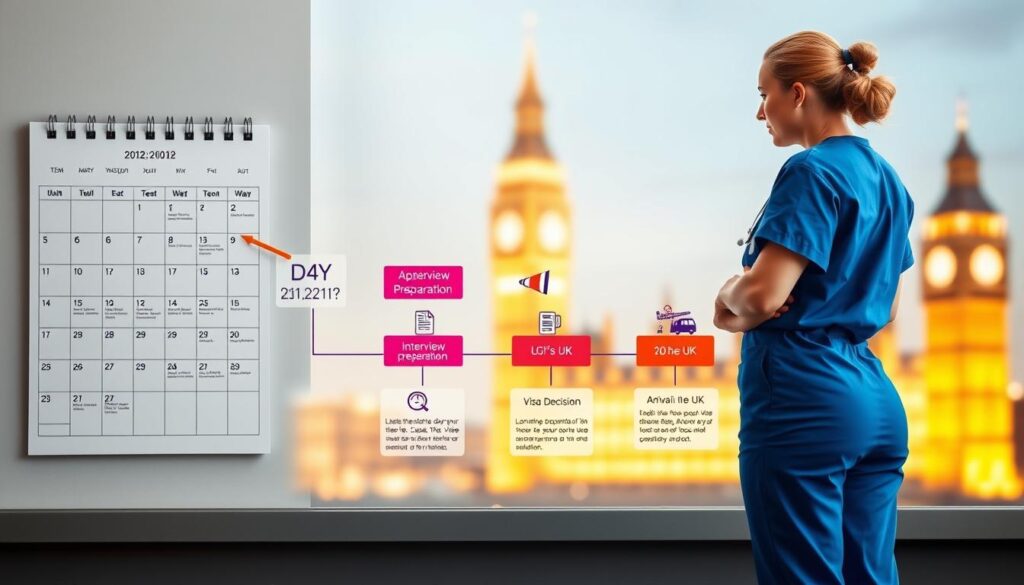
Timeline for UK Nursing Visa Applications
Knowing the timeline for UK nursing visa applications is key for nurses from abroad wanting to work in the UK in 2026. The process has several steps, from applying to getting a decision.
Processing Times
The time it takes to process UK nursing visa applications can change. Usually, it’s about 3 weeks for a Health and Care Worker visa application decision. But, it might take longer if more documents are needed or if there are application issues.
Planning Your Application
To plan well, you should:
- Make sure all needed documents are ready before you apply.
- Apply early to avoid delays.
- Check your application status online through the UK Visa and Immigration portal.
Understanding the UK nursing visa timeline and planning ahead helps nurses smoothly go through the application. This way, they can start their new roles in the UK on time.
Relocating to the UK: Practical Considerations
Relocating to the UK for nursing jobs needs careful planning. You’ll need to find a place to live and understand the local healthcare system. Nurses moving here should be ready for various challenges.
Housing and Accommodation
Finding good housing is key. Many employers help with this or offer discounted housing. You can also look at local estate agents or online for rentals. It’s smart to check out neighborhoods close to work to cut down on travel time.
Banking and Healthcare Access
Getting a UK bank account is crucial for getting paid and managing money. Big banks have services for international clients, and some have special deals for expats. Nurses will get NHS services once they’re employed, but knowing how to register is important.
Cultural Adaptation and Support Networks
Getting used to UK culture can be tough. Joining nursing groups or social clubs can help a lot. Many healthcare places also have programs to help new staff get used to the culture.
| Practical Considerations | Tips for Nurses |
|---|---|
| Housing | Research neighborhoods, consider employer assistance |
| Banking | Choose a bank with expat services, set up a UK account |
| Healthcare Access | Understand NHS registration, check employer-provided health insurance |
| Cultural Adaptation | Join professional or social groups, participate in cultural orientation |
By tackling these practical issues, nurses moving to the UK can make their transition smoother. They’ll be better prepared for their new roles and lives.
Pathways to Settlement for Nurses in the UK
Settlement in the UK is a big deal for nurses. It’s important to know how to get there. The UK has a clear way for nurses to settle down after helping the healthcare system a lot.
Indefinite Leave to Remain Requirements
To get Indefinite Leave to Remain (ILR), nurses must live in the UK for 5 years. They need to pass the Life in the UK test and show they can speak English well.
Citizenship Options
With ILR, nurses can apply for UK citizenship. They need to live in the UK for a while, show they’re a good person, and pass the Life in the UK test if they haven’t already. Nurses should get their documents ready and check they meet all the rules.
Conclusion
Nurses wanting to move to the UK have new career chances with UK visa sponsorship. The steps include checking if you’re eligible, finding employers who can sponsor, and applying for a visa.
To move to the UK, nurses must know the visa rules. This includes getting registered with the Nursing and Midwifery Council (NMC) and proving you can speak English well.
By following this guide, nurses can get through the visa sponsorship process. This opens doors to a new career in the UK. With more healthcare jobs needed, moving to the UK can be both rewarding and challenging.
Nurses should start planning their move to the UK. Use the visa sponsorship for nurses to find new opportunities.